

Skip to the content

Institute of Sustainability and Climate Change (ISCC)

CDT in Sustainable Chemical Technologieslogo darklogo light
Apply Now
CDT in Sustainable Chemical Technologies
  • Main Home
  • About Us
  • Research
  • PhD Programme
  • Applications
  • Public Engagement
  • People
  • Work With Us
  • News, Blogs & Events
News

Bath Chancellor learns more about sustainable technologies research in visit to CSCT

CSCT admin
10/12/2021

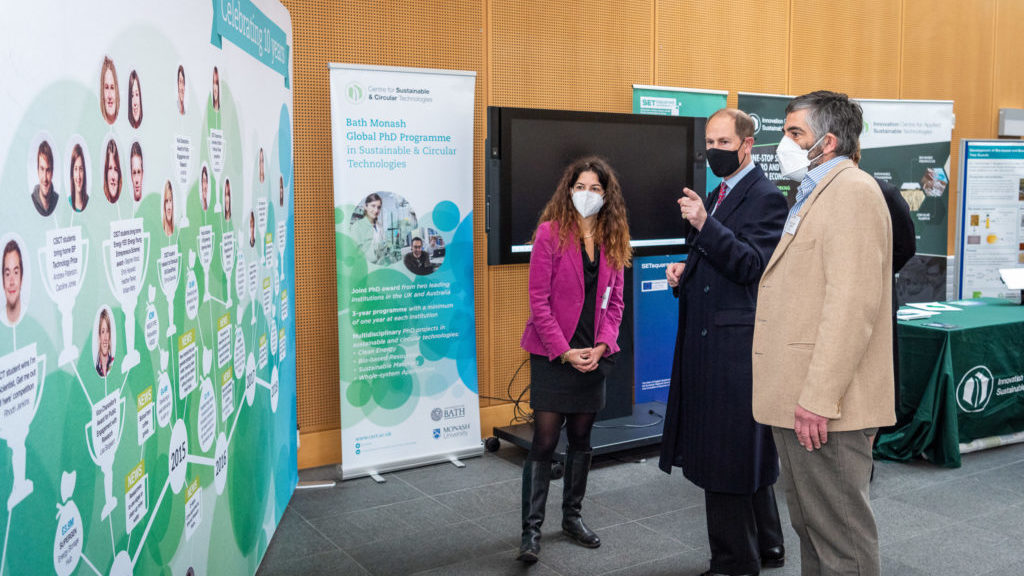
Image: University of Bath.

The Centre for Sustainable and Circular Technologies (CSCT) hosted a visit by the University’s Chancellor, HRH The Earl of Wessex, to learn more about the Centre’s achievements and vision for the future.

As a cross-disciplinary research centre spanning the Faculties of Science, Engineering and Humanities & Social Science, CSCT research includes developing clean energy technologies, replacing crude oil products in plastics and pharmaceuticals with sustainable alternatives and minimising the environmental impact of industrial chemical processes.

During the visit, The Chancellor heard about the vision of the CSCT in making a significant contribution to breaking the global economy’s unsustainable reliance on fossil carbon. He found out more about research from many of the different areas of the Centre’s work, by meeting CSCT researchers who presented a range of projects – from making sustainable biodegradable tree guards, through membrane separation technologies and people-led digitalisation, to tracking Covid19 in the sewage system.

Besides learning about the history of the Centre and its research accomplishments, and its unique international joint PhD programme with Monash University, the Chancellor was also informed about the latest successes of the innovation strand of the CSCT – the West of England Sustainable Technologies Scale-Up Programme (WoESTSP) and the newly launched Innovation Centre for Applied Sustainable Technologies (iCAST), which facilitates collaboration between businesses and academics to bring new sustainable technologies to market.

He was also briefed on the industrial decarbonisation and sustainable energy systems initiatives at Bath, including the UK Industrial Decarbonisation Research and Innovation Centre (IDRIC) and the SuperGen Bioenergy Hub.

Three of the Centre’s past and current Whorrod Fellows described their recent research and, finally, the Chancellor got the opportunity to hear from PhD students about their research and public engagement activities.

Professor Matthew Davidson, Co-Director of the CSCT and Director of iCAST, said: “We’re delighted to have had this opportunity to showcase our ongoing projects to the Chancellor, from the flagship research projects to our collaborative projects with industry.

“This is particularly timely as we transition the CSCT into an institute in the coming year.”
iCASTIDRICinnovationPublic EngagementresearchWoESTSP
Share share
  • .face-icon{fill:#fff;}
  • .tw-icon{fill:#fff;}
  • .ln-icon{fill:#fff;}
  • .pn-icon{fill:#fff;}

Related articles

News Public Engagement
CSCT students to engage Glastonbury crowds with sustainability
CSCT admin
21/05/2019
News
Festival of Tomorrow 2025 & Our Collaboration with iCAST
CSCT admin
24/02/2025
News
National neutron scattering prize awarded to Dr O’Malley
CSCT admin
09/05/2022
Links
  • Disclaimer
  • Freedom of information
  • Contact
Policies
  • Privacy policy
  • UoB Data Policy
  • A.I. Policy
Location
  • East Building
  • Room 3.02
  • Claverton Down
  • Bath
  • BA27AY
  • Map

© 2025 CSCT, All Rights Reserved

Back to top Drag
w
  • Main Home
  • About Us
  • Research
  • PhD Programme
  • Applications
  • Public Engagement
  • People
  • Work With Us
  • News, Blogs & Events

Academic Supervision

Research project 2​​​​​

The second research project will normally be executed in a different discipline and on a different topic compared to Research Project 1 to foster a better appreciation of the interdisciplinary aspects of research in sustainable chemical technologies. Research project 2 could be close to the topic of your PhD or at least in the same research group. You will select the topic for Research Project 2 at the start of Semester 2. It is compulsory to have a different supervisor for Project 2 to that of Project 1. You will present your findings in the form of a report and a poster.

25 Credits

Academic Supervision

Research project 1​​​​​

Under the guidance of an academic supervisor, you will undertake a research project focused on sustainable chemical technologies and system thinking. During the first stage, you will undertake the necessary background reading, carry out appropriate safety assessments and devise a programme of work. At the end of the first stage, you will submit a short, formative report to your project supervisor. During the second stage of the project, you will carry out the research according to your work programme in consultation with your supervisor.

25 Credits

Broader training

Public and policy engagement​​​​​

Introduction to basic concepts of public and policy engagement (PPE) with science, technology, engineering and maths and the contexts in which it takes place. You will cover a wide range of approaches to PPE and audiences for PPE. As part of this unit, you will have opportunities for engaging in practical PPE work to help you build your skills and confidence when embarking upon PPE activities.  ​

For more information see our Public Engagement page

5 Credits

Sustainable Chemical Technologies

Commercialisation of new technology​​​​​

Learn how to develop an idea into a business concept and a marketable product. You will learn techniques and tools necessary to analyse the different pathways for new technologies to be effectively commercialised.​

5 Credits

Sustainable Chemical Technologies

Water cycle and human health​​​​​

Study the impact of human populations on the global environment, focusing specially on water resources. You will explore water as a limited resource, methodologies for water resource management and the importance of water research for human population health. ​

5 Credits

Sustainable Chemical Technologies

Systems Thinking 4: Green chemistry and process metrics​​

Develop a detailed understanding of scientific methodologies for the qualitative and quantitative assessment of chemical processes in terms of environmental, economic, and social impacts. Through case studies you will develop practical skills in defining appropriate system boundaries and selecting, applying and evaluating key sustainability metrics. ​

5 Credits

Sustainable Chemical Technologies

Materials for sustainable energy​​​​

Explore how the skills of chemists and engineers contribute to the development of materials and processes for sustainable energy solutions. You will study materials storage and conversion technologies such as batteries, fuel cells or hydrogen storage and explore challenges in their synthesis, fabrication, and application.​

5 Credits

Sustainable Chemical Technologies

Catalysis and sustainability​​​

Develop your knowledge and understanding of how catalysis can provide lower cost, less energy-consuming and more environmentally friendly processes both  an industrial and laboratory scale using industrial and academic examples. ​

5 Credits

Sustainable Chemical Technologies

AI and machine learning for sustainable chemical technology​​

Working individually and in teams, you will use software tools to learn core AI and ML methods and apply workflows to prepare, process, and analyse data. You will explore how to harness AI and machine learning to tackle sustainability issues in key areas such as energy, environmental pollution, circular economy, and decarbonisation​

5 Credits

Cross Disciplinary Training

Fundamentals of biotechnology for non-biologists​

Introduce the fundamentals of molecular cell biology and bioprocess engineering. ​

5 Credits

Cross Disciplinary Training

Fundamentals of chemistry for non-chemists​

You will develop core knowledge of organic, inorganic, physical and analytical chemistry.​

5 Credits

Cross Disciplinary Training

Fundamentals of chemical engineering for non-chemical engineers​

Explore the principles and practices of chemical engineering and chemical engineering processes. Using case studies from chemical and biochemical engineering, you will learn about material and energy balances as well as the principles of reaction engineering and their application to chemical and biological reactor design preparing you to work effectively in multidisciplinary teams.​

5 Credits

Systems Thinking 3

Principles and practice of industrial ecology​

Industrial Ecology is the quantification of material and energy flows through industrial systems, from ‘cradle to grave’. This allows us to evaluate and minimise the environmental footprint of our technologies and activities. In this unit, you will explore the principles and practice of industrial ecology for the development of sustainable molecules, materials, and processes.  ​

5 Credits

Systems Thinking 2

Circular economy and resource efficiency

Explore the principles and practices of the circular economy and its application to sustainable chemical technologies and resource management. Taking a whole systems approach, you will get an insight how to design resource efficient chemical processes that minimise raw material consumption and waste or use waste as a resource. ​

5 Credits

Systems Thinking 1

Sustainable Development​

Explore the social, economic, cultural, ethical, and political context of sustainable chemical technologies and assess their sustainability. You will gain an understanding how to consider and respond appropriately to sustainable development needs in your decision-making. Working in multi-disciplinary groups you will conduct a case study to explore motivations and priorities of different stakeholders. ​

5 Credits