

Skip to the content

Institute of Sustainability and Climate Change (ISCC)

CDT in Sustainable Chemical Technologieslogo darklogo light
Apply Now
CDT in Sustainable Chemical Technologies
  • Main Home
  • About Us
  • Research
  • PhD Programme
  • Applications
  • Public Engagement
  • People
  • Work With Us
  • News, Blogs & Events
News Public Engagement

Successful Reaction Monitoring Symposium

CSCT admin
30/11/2017

On 6 November, the first Reaction Monitoring Symposium brought together members of the chemical community to celebrate the opening of the EPSRC-funded Dynamic Reaction Monitoring (DReaM) Facility at the University of Bath. Held in the Edge, the symposium attracted over 90 participants from both industrial and academic institutions situated in five countries.

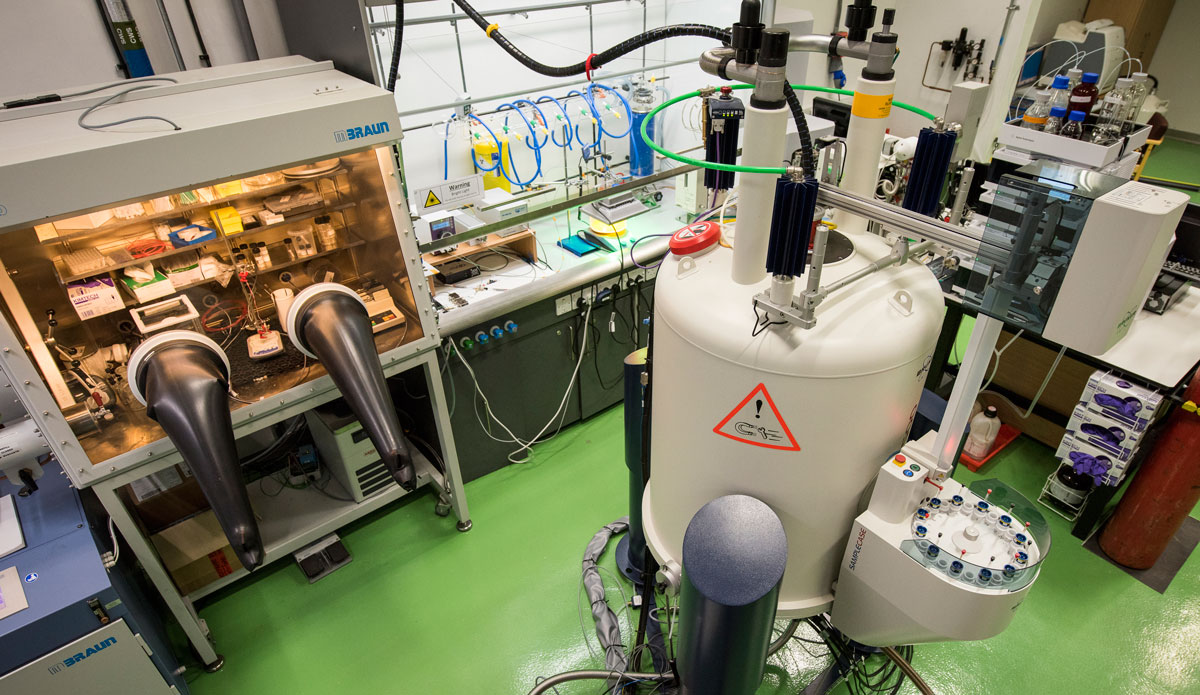
The DReaM Facility allows researchers to monitor homogeneous reactions in real-time, under their normal reaction conditions, with a variety of analytical techniques. As well as kinetic data, the DReaM Facility can also help researchers shed light on reaction intermediates and by-products, allowing a comprehensive picture of all aspects of the reaction in solution to be constructed.

Invited speakers Professor Guy Lloyd-Jones (University of Edinburgh), Professor Andrew Weller (University of Oxford), Professor John Blacker (University of Leeds) and Dr Ulrich Hintermair (CSCT, University of Bath) gave captivating talks on their experiences. One of the interesting aspects (and conversely, challenges) of reaction monitoring is the wide range of chemical disciplines it spans, so hearing perspectives from people who work in the branches of organic chemistry, inorganic chemistry and process chemistry was particularly enlightening for the delegates.

Attendees were then given the opportunity to see the DReaM set-up first hand and consider whether their own research could benefit from similar analytical techniques. The day concluded with a round table discussion, facilitated by industrial partners of the DReaM facility – Dr Anna Codina (Bruker), Dr Steven Coombes (AstraZeneca), Dr Clemens Minnich (S-PACT GmbH) and Dr Antonio Zanotti-Gerosa (Johnson Matthey). The key topic, “What challenges and opportunities will reaction monitoring face in the future?”, generated lively debate and a lot of audience participation.

CSCT Whorrod Research Fellow Dr Ulrich Hintermair is the scientific lead on this project, He said: “We are obviously very proud of this new Facility that we have set up here at Bath over the past year, and it was fantastic to see that so many colleagues from a variety of disciplines and sectors share our enthusiasm for real-time reaction monitoring. We’re now looking forward to push the boundaries of science and engineering even further, and use our unique setup for ground-breaking discoveries in catalysis for sustainable chemistry.”

External Users

Interested in using the DReaM facility? We welcome users from industry and academia to apply for time at the facility. See more details. This call is now open and will close on 31 January 2018 and time will be scheduled in mid-2018.

We would like to thank the RSC Faraday Division and the Catalysis Hub for their generous funding, as well as PhD students Andrew Hall (CSCT), Isabel Thomlinson (CSCT), Rachael Broomfield-Tagg and Dan Berry for guiding tours.

Share share
  • .face-icon{fill:#fff;}
  • .tw-icon{fill:#fff;}
  • .ln-icon{fill:#fff;}
  • .pn-icon{fill:#fff;}

Related articles

News
Dr Hannah Leese receives IChemE medal for her work in early detection of disease
CSCT admin
28/02/2022
News
Tracking COVID-19 through monitoring wastewater in cities in the UK and Africa
CSCT admin
14/09/2020
News Public Engagement
ISCC Students Win 3rd Prize at Bright SCIdea Poster Competition with Innovative Vaccine Delivery Concept
CSCT admin
01/05/2025
Links
  • Disclaimer
  • Freedom of information
  • Contact
Policies
  • Privacy policy
  • UoB Data Policy
  • A.I. Policy
Location
  • East Building
  • Room 3.02
  • Claverton Down
  • Bath
  • BA27AY
  • Map

© 2025 CSCT, All Rights Reserved

Back to top Drag
w
  • Main Home
  • About Us
  • Research
  • PhD Programme
  • Applications
  • Public Engagement
  • People
  • Work With Us
  • News, Blogs & Events

Academic Supervision

Research project 2​​​​​

The second research project will normally be executed in a different discipline and on a different topic compared to Research Project 1 to foster a better appreciation of the interdisciplinary aspects of research in sustainable chemical technologies. Research project 2 could be close to the topic of your PhD or at least in the same research group. You will select the topic for Research Project 2 at the start of Semester 2. It is compulsory to have a different supervisor for Project 2 to that of Project 1. You will present your findings in the form of a report and a poster.

25 Credits

Academic Supervision

Research project 1​​​​​

Under the guidance of an academic supervisor, you will undertake a research project focused on sustainable chemical technologies and system thinking. During the first stage, you will undertake the necessary background reading, carry out appropriate safety assessments and devise a programme of work. At the end of the first stage, you will submit a short, formative report to your project supervisor. During the second stage of the project, you will carry out the research according to your work programme in consultation with your supervisor.

25 Credits

Broader training

Public and policy engagement​​​​​

Introduction to basic concepts of public and policy engagement (PPE) with science, technology, engineering and maths and the contexts in which it takes place. You will cover a wide range of approaches to PPE and audiences for PPE. As part of this unit, you will have opportunities for engaging in practical PPE work to help you build your skills and confidence when embarking upon PPE activities.  ​

For more information see our Public Engagement page

5 Credits

Sustainable Chemical Technologies

Commercialisation of new technology​​​​​

Learn how to develop an idea into a business concept and a marketable product. You will learn techniques and tools necessary to analyse the different pathways for new technologies to be effectively commercialised.​

5 Credits

Sustainable Chemical Technologies

Water cycle and human health​​​​​

Study the impact of human populations on the global environment, focusing specially on water resources. You will explore water as a limited resource, methodologies for water resource management and the importance of water research for human population health. ​

5 Credits

Sustainable Chemical Technologies

Systems Thinking 4: Green chemistry and process metrics​​

Develop a detailed understanding of scientific methodologies for the qualitative and quantitative assessment of chemical processes in terms of environmental, economic, and social impacts. Through case studies you will develop practical skills in defining appropriate system boundaries and selecting, applying and evaluating key sustainability metrics. ​

5 Credits

Sustainable Chemical Technologies

Materials for sustainable energy​​​​

Explore how the skills of chemists and engineers contribute to the development of materials and processes for sustainable energy solutions. You will study materials storage and conversion technologies such as batteries, fuel cells or hydrogen storage and explore challenges in their synthesis, fabrication, and application.​

5 Credits

Sustainable Chemical Technologies

Catalysis and sustainability​​​

Develop your knowledge and understanding of how catalysis can provide lower cost, less energy-consuming and more environmentally friendly processes both  an industrial and laboratory scale using industrial and academic examples. ​

5 Credits

Sustainable Chemical Technologies

AI and machine learning for sustainable chemical technology​​

Working individually and in teams, you will use software tools to learn core AI and ML methods and apply workflows to prepare, process, and analyse data. You will explore how to harness AI and machine learning to tackle sustainability issues in key areas such as energy, environmental pollution, circular economy, and decarbonisation​

5 Credits

Cross Disciplinary Training

Fundamentals of biotechnology for non-biologists​

Introduce the fundamentals of molecular cell biology and bioprocess engineering. ​

5 Credits

Cross Disciplinary Training

Fundamentals of chemistry for non-chemists​

You will develop core knowledge of organic, inorganic, physical and analytical chemistry.​

5 Credits

Cross Disciplinary Training

Fundamentals of chemical engineering for non-chemical engineers​

Explore the principles and practices of chemical engineering and chemical engineering processes. Using case studies from chemical and biochemical engineering, you will learn about material and energy balances as well as the principles of reaction engineering and their application to chemical and biological reactor design preparing you to work effectively in multidisciplinary teams.​

5 Credits

Systems Thinking 3

Principles and practice of industrial ecology​

Industrial Ecology is the quantification of material and energy flows through industrial systems, from ‘cradle to grave’. This allows us to evaluate and minimise the environmental footprint of our technologies and activities. In this unit, you will explore the principles and practice of industrial ecology for the development of sustainable molecules, materials, and processes.  ​

5 Credits

Systems Thinking 2

Circular economy and resource efficiency

Explore the principles and practices of the circular economy and its application to sustainable chemical technologies and resource management. Taking a whole systems approach, you will get an insight how to design resource efficient chemical processes that minimise raw material consumption and waste or use waste as a resource. ​

5 Credits

Systems Thinking 1

Sustainable Development​

Explore the social, economic, cultural, ethical, and political context of sustainable chemical technologies and assess their sustainability. You will gain an understanding how to consider and respond appropriately to sustainable development needs in your decision-making. Working in multi-disciplinary groups you will conduct a case study to explore motivations and priorities of different stakeholders. ​

5 Credits