
Circular Feedstocks and Processes
The Circular Feedstock and Process theme supports innovative research to create a more sustainable and circular future for materials and manufacturing. We explore how waste, biomass and renewable resources can be transformed into valuable products, while developing greener materials and processes. Our research spans plastic recycling, biomass conversion, waste valorisation and sustainable manufacturing, bringing together chemistry, engineering and materials science to address real-world challenges and develop solutions with impact across the circular economy.
Key research areas within this theme

Catalysis

Synthesis

Bio

Reaction

Process
Research in practice
Exemplar projects
Explore examples of the interdisciplinary research students could undertake within this theme.
Project example
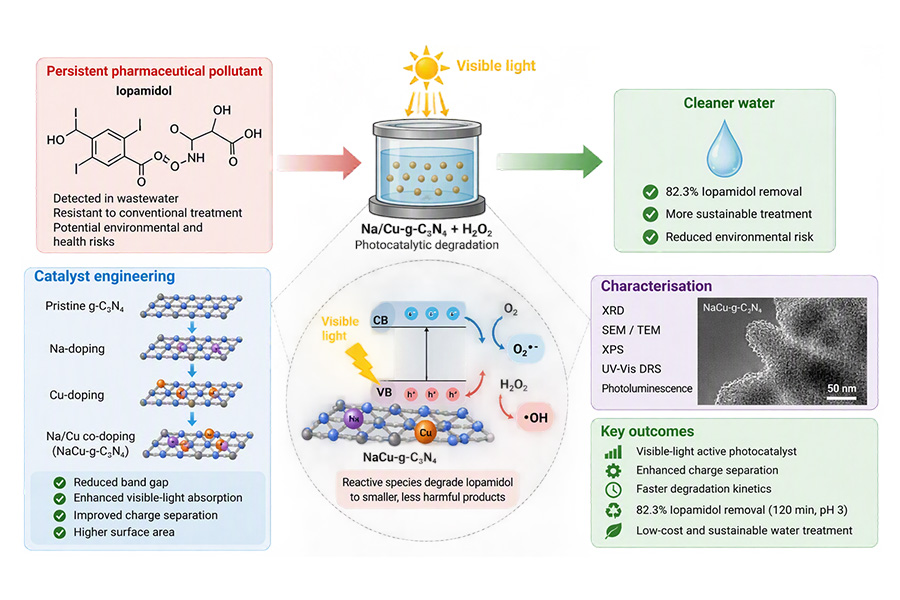
Using Sunlight to Remove Pollutants from Water
Emerging contaminants such as pharmaceutical residues are increasingly detected in water bodies, and compounds such as Iopamidol, a widely used iodinated X-ray contrast agent, are particularly challenging because they are persistent, difficult to remove by conventional wastewater treatment, and can lead to the formation of… View project Close project
Emerging contaminants such as pharmaceutical residues are increasingly detected in water bodies, and compounds such as Iopamidol, a widely used iodinated X-ray contrast agent, are particularly challenging because they are persistent, difficult to remove by conventional wastewater treatment, and can lead to the formation of toxic disinfection by-products. Visible-light photocatalysis offers a sustainable treatment route, but commonly used graphitic carbon nitride (g-C₃N₄) suffers from limited surface area, suboptimal visible-light absorption, and inefficient charge separation, which restrict its photocatalytic performance.
Our research develops sodium and copper co-doped graphitic carbon nitride (NaCu-g-C₃N₄) photocatalysts for the visible-light degradation of persistent water contaminants. By engineering the electronic structure and surface properties of carbon nitride through Na/Cu co-doping, we enhance visible-light absorption, reduce the bandgap, improve charge transfer, and increase the surface area available for photocatalytic reactions. Comprehensive materials characterization is used to relate structural and electronic modifications to photocatalytic activity and identify the factors governing catalyst performance.
Photocatalytic and mechanistic studies show that the optimized NaCu-g-C₃N₄/H₂O₂ system achieves efficient degradation of Iopamidol under visible light, outperforming pristine carbon nitride. These insights support the development of low-cost, visible-light-active photocatalysts for sustainable water treatment and the removal of emerging contaminants.
References
- “Na/Cu-Doping Engineering of Carbon Nitride for High-Performance Visible-Light Degradation of Iopamidol” Small Sci. 2026, 6, e70341.
Project example
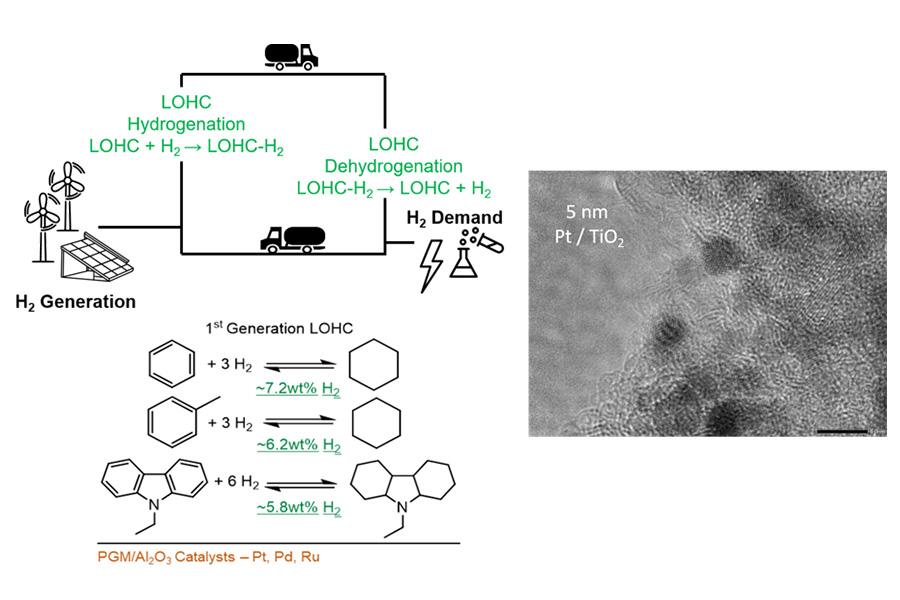
Heterogeneous Catalysis Development of Cyclic Hydrogen Storage
Liquid organic hydrogen carriers (LOHCs) offer a promising route for storing and transporting hydrogen using liquid molecules that can be reversibly hydrogenated and dehydrogenated. Alcohol and polyol-based LOHCs are particularly attractive because they can be derived from renewable resources and potentially store hydrogen at useful… View project Close project
Liquid organic hydrogen carriers (LOHCs) offer a promising route for storing and transporting hydrogen using liquid molecules that can be reversibly hydrogenated and dehydrogenated. Alcohol and polyol-based LOHCs are particularly attractive because they can be derived from renewable resources and potentially store hydrogen at useful densities. However, current catalysts often require high precious-metal loadings and can promote unwanted C–O and C–C bond cleavage, reducing selectivity and carrier lifetime. Developing efficient, selective and lower-cost catalysts is therefore essential for practical LOHC systems. Our research develops catalysts for the reversible hydrogenation and dehydrogenation of alcohol and hydrocarbon based LOHCs, enabling efficient hydrogen storage and release while minimising unwanted bond cleavage and catalyst deactivation. By combining systematic catalyst design with kinetic, isotopic and spectroscopic studies, we investigate elementary reaction steps, including the role of hydrogen radicals and background C–H scrambling, to identify the active sites and pathways that control performance. These insights inform the development of efficient, selective and low-precious-metal catalysts. Process and energy modelling assesses heat and energy requirements, efficiency and scalability, connecting catalyst performance with practical LOHC-based hydrogen storage systems.
Project example
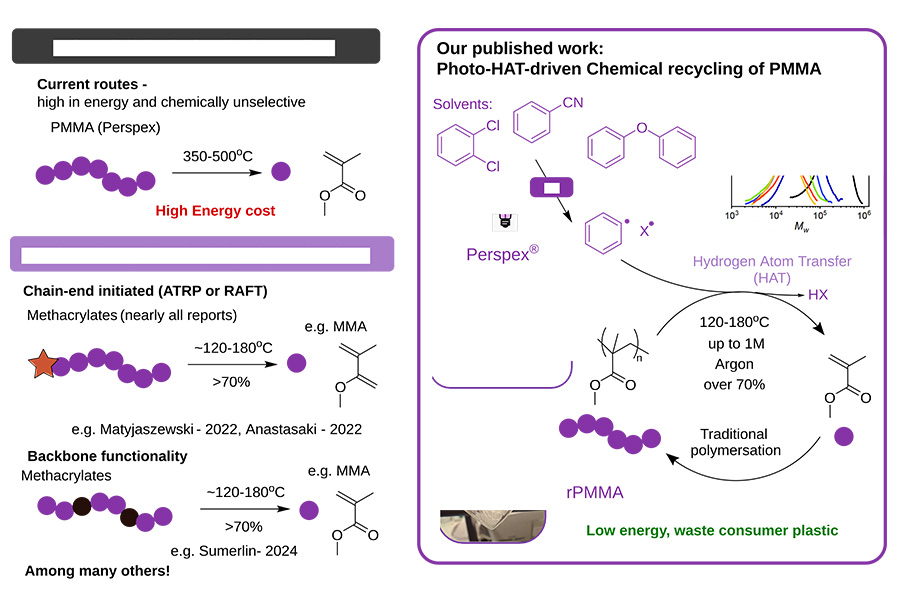
Developing low-temperature Hydrogen Atom Transfer (HAT) initiated chemical recycling of Perspex®
Plastics derived from vinyl and olefinic monomers represent a major component of global plastic waste, yet effective recycling routes for these materials remain limited. Chemical recycling offers the potential to recover high-value monomers from waste plastics, enabling the production of new materials without loss of… View project Close project
Plastics derived from vinyl and olefinic monomers represent a major component of global plastic waste, yet effective recycling routes for these materials remain limited. Chemical recycling offers the potential to recover high-value monomers from waste plastics, enabling the production of new materials without loss of performance while also tolerating contamination and mixed-feed waste streams that are challenging for conventional mechanical recycling.
However, recycling vinyl plastics such as polystyrene, PMMA (Perspex®) and PVC typically relies on thermolysis above 400°C, resulting in high energy demands and poor selectivity. The Husband, Freakley and Davidson groups have recently developed a scalable depolymerisation method for PMMA that operates below 200°C. The approach uses light to generate radicals from the photolysis of substituted aromatics. These radicals facilitate Hydrogen Atom Transfer (HAT) to generate polymer radicals, which under favourable thermodynamic conditions, trigger selective depolymerisation back to monomer.
References
- “Photo-Initiated Solvent-Mediated Depolymerization of Consumer Poly(methyl methacrylate) without Chlorinated Reagents” Nat. Commun. 2026, 17, 1235.
Facilities and capabilities
Advanced Materials Characterisation
Researchers in Circular Feedstocks and Processes have access to advanced characterisation techniques for investigating the structure, composition and behaviour of materials. These include electron microscopy, X-ray diffraction, Raman spectroscopy, mass spectrometry and optical methods such as UV-Vis and photoluminescence. Together, these capabilities help researchers understand how material properties influence performance in energy storage, conversion and other functional applications.
Facilities
Lorem ipsum dolor sit amet, consectetur adipiscing elit. Ut elit tellus, luctus nec ullamcorper mattis, pulvinar dapibus leo.
Meet the researchers
Dr Simon Freakley
Chemistry
View profile›

Dr Antonio Exposito
Chemical Engineering
View profile›

Dr Bernardo Dominguez
Chemical Engineering
View profile›

Dr Clare Rees-Zimmerman
Chemical Engineering
View profile›

Professor Davide Mattia
Chemical Engineering
View profile›

Dr Emma Emanuelsson-Patterson
Chemical Engineering
View profile›

Dr Hannah Leese
Chemical Engineering
View profile›

Dr Jon Husband
Chemistry
View profile›
Kevin Paine
Dr Maciek Kopec
Chemistry
View profile›

Professor Matthew Jones
Chemistry
View profile›

Dr Rick Lupton
Mechanical Engineering
View profile›Rox Middleton
Dr Sanjay Nagarajan
Chemical Engineering
View profile›

Dr Stephen Doliente
Chemical Engineering
View profile›

Susan Bernal Lopez
Dr Ulrich Hintermair
Chemistry
View profile›Interested in this research theme?
Connected research
Explore our research themes
Our research themes are distinct but interconnected, combining expertise across disciplines to address complex sustainability challenges.