
Sustainable Synthesis and Catalysis
The Sustainable Synthesis & Catalysis theme develops new reactions, catalytic processes and enabling technologies to transform how molecules and materials are made. We address fundamental challenges in chemical synthesis: reducing waste, energy and resource consumption; replacing hazardous and stoichiometric processes; exploiting renewable and waste-derived feedstocks; and developing shorter, more selective routes to valuable chemical products. Our goal is not simply to make existing chemistry greener, but to invent better ways of doing chemistry.
Key research areas within this theme

Catalysis

Synthesis

Bio

Reaction

Process
Research in practice
Exemplar projects
Explore examples of the interdisciplinary research students could undertake within this theme.
Project example
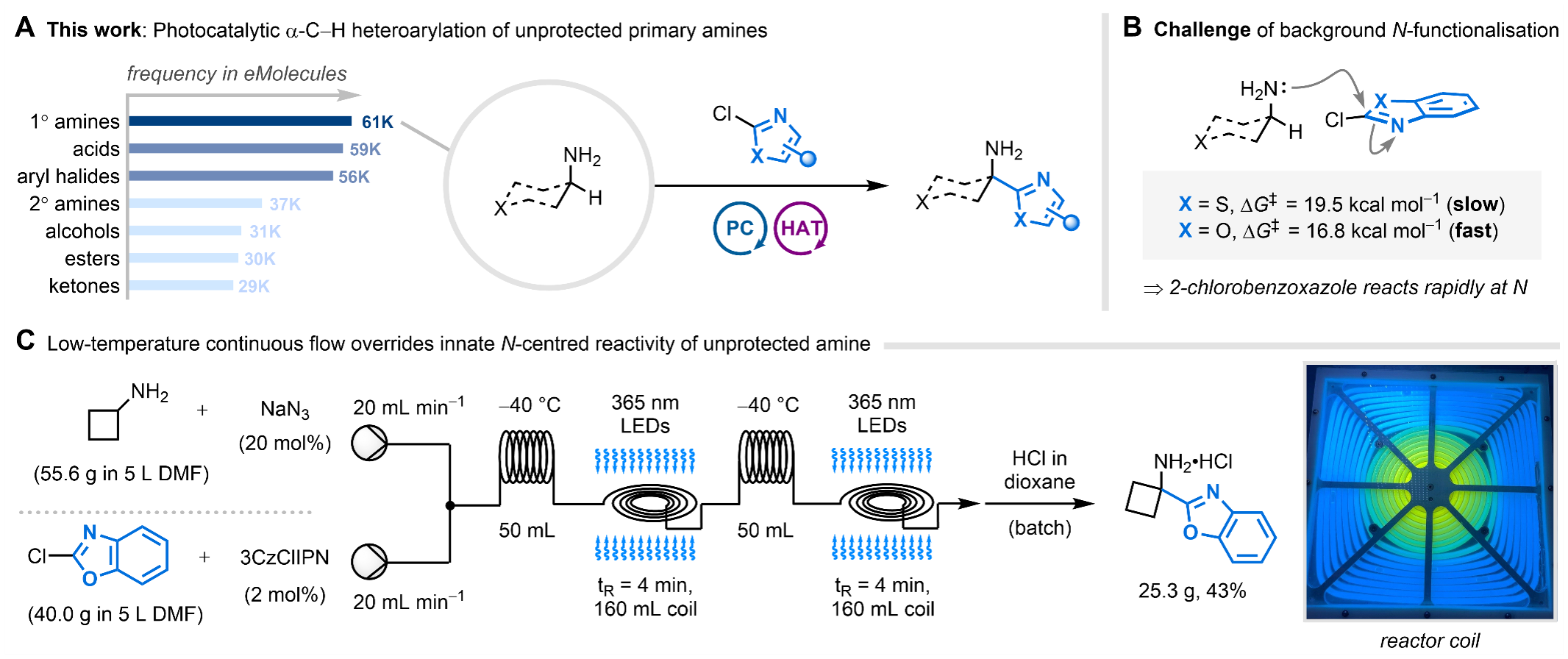
Reprogramming Alkylamine Reactivity Using Visible Light
Our research develops new catalytic strategies to reprogramme the innate reactivity of simple amines, enabling direct access to complex, medicinally relevant nitrogen-containing molecules. We are particularly interested in selective C–H functionalisation of unprotected primary and secondary alkylamines, using photoredox catalysis, hydrogen-atom transfer and continuous-flow chemistry… View project Close project
Our research develops new catalytic strategies to reprogramme the innate reactivity of simple amines, enabling direct access to complex, medicinally relevant nitrogen-containing molecules. We are particularly interested in selective C–H functionalisation of unprotected primary and secondary alkylamines, using photoredox catalysis, hydrogen-atom transfer and continuous-flow chemistry to form C–C bonds at positions that are traditionally difficult to functionalise. More broadly, we aim to develop step- and atom-efficient routes to saturated heterocycles and three-dimensional building blocks for drug discovery. The example shown illustrates this approach through direct α-C–H heteroarylation of unprotected primary amines, overriding their usual preference for reaction at nitrogen.
References
- “Scalable Photocatalytic Annulation of Primary Amines to δ-Lactams: Access to Privileged (Spiro)Piperidine Space” Org. Lett. 2026, 28, 9603.
- “Direct α-C−H Heteroarylation of Unprotected Primary Amines” ACS Catal. 2026, 16, 10290.
- “Modular, Automated Synthesis of Spirocyclic Tetrahydronaphthyridines from Primary Alkylamines” Commun. Chem. 2023, 6, 215.
- “Photocatalytic Hydroaminoalkylation of Styrenes with Unprotected Primary Alkylamines” J. Am. Chem. Soc. 2021, 143, 15936
- “Photocatalytic α‐Tertiary Amine Synthesis via C−H Alkylation of Unmasked Primary Amines” Angew. Chem. Int. Ed. 2020, 59, 14986.
View full-size image for Mining Precious Metal Reactivity from Earth-Abundant Main Group Compounds
02
Project example
Mining Precious Metal Reactivity from Earth-Abundant Main Group Compounds
Precious metals such as platinum, palladium, and iridium play crucial catalytic roles throughout chemistry, for the synthesis of everything from bulk chemicals to fine products. However, as their name implies, precious metals present major problems for sustainable synthesis. Aside from the obvious cost and scarcity… View project Close project
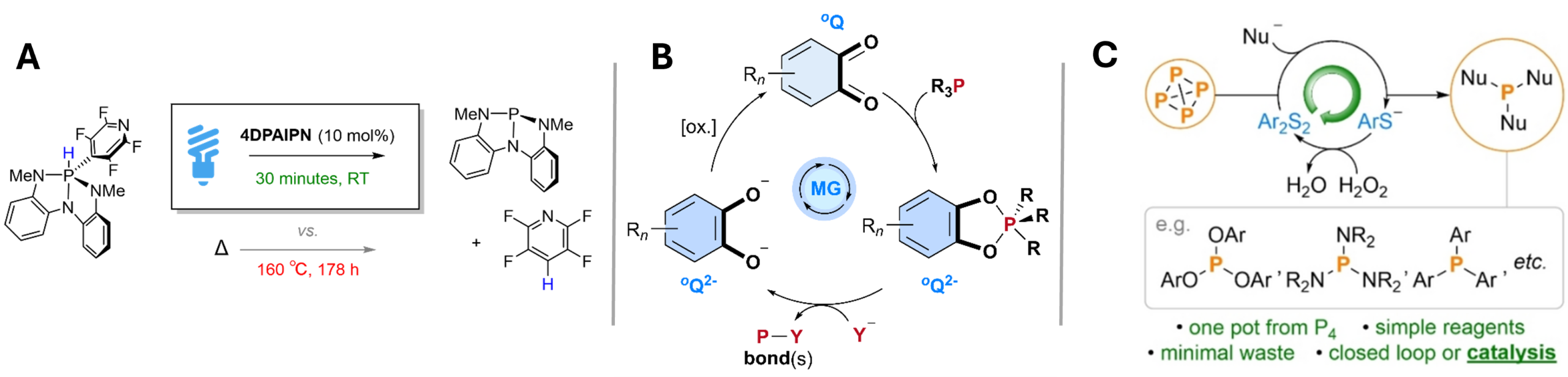
Precious metals such as platinum, palladium, and iridium play crucial catalytic roles throughout chemistry, for the synthesis of everything from bulk chemicals to fine products. However, as their name implies, precious metals present major problems for sustainable synthesis. Aside from the obvious cost and scarcity issues, precious metal extraction suffers from an enormous environmental footprint, while precious metal contamination can lead to context-sensitive problems such as toxicity in pharmaceuticals or reduced performance in advanced organic materials. These problems would be avoided if precious metals’ catalytic performance could be reproduced using earth abundant main group elements, but this is normally very challenging. To address this, we have been developing new strategies to allow main group elements to display “precious metal-like” reactivity, including by “turbocharging” elementary steps such as reductive elimination via photocatalysis (A) and exploiting the innate reactivity of simple ortho-quinones to design new types of catalytic cycles (B). We are also interested in “green” main group chemistry more generally, including the sustainable use of P4 as a P atom source (C).
References
- “Photocatalytic Reductive Elimination from a Main group Centre” ChemRxiv 2026, doi: 10.26434/chemrxiv.15006857/v1.
- “One-Pot Synthesis of Primary Phosphines from White Phosphorus” Chem. Commun. 2025, 61, 12721.
- “Closing the Loop: Low-Waste Phosphorus Functionalization Enabled by Simple Disulfides” ChemSusChem 2024, 17, e202401895.
- “Unravelling White Phosphorus: Experimental and Computational Studeis Reveal the Mechanisms of P4 Hydrostannylation” Angew. Chem. Int. Ed. 2024, 63, e202408423.
- “Synthesis of Monophosphines Directly from White Phosphorus” Nat. Chem. 2021, 13, 458.
Project example
Watching Catalysts at Work
Our work in the Dynamic Reaction Monitoring (DReaM) Facility develops and applies new spectroscopic methods for the non-invasive, real-time (“operando”) analysis of chemical reactions – live & direct, as they happen – to understand the origin of chemical reactivity in complex systems, fix whatever may… View project Close project
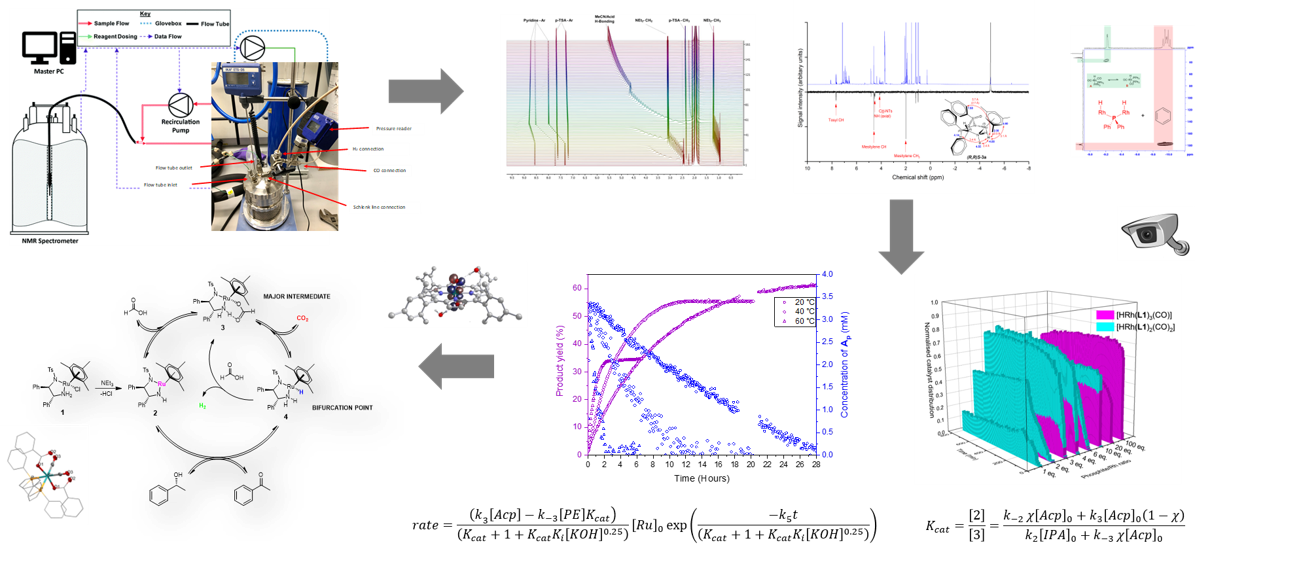
Our work in the Dynamic Reaction Monitoring (DReaM) Facility develops and applies new spectroscopic methods for the non-invasive, real-time (“operando”) analysis of chemical reactions – live & direct, as they happen – to understand the origin of chemical reactivity in complex systems, fix whatever may be limiting its true potential, and use the knowledge to develop new reactions and catalysts. This includes advanced high-resolution FlowNMR methods, reaction progress kinetic analyses, catalytic reaction mechanisms, and organometallic chemistry. In close collaboration with industry, we apply this approach to a range of important transformations including asymmetric hydrogenation, hydroformylation, epoxidation, dehydrogenation, photoredox catalysis, electrocatalysis and rearrangement reactions to derive new insights that enable rational improvements in efficiency.
References
- “Flow NMR for Chemical Synthesis” Nat. Rev. Methods Primers 2026, 6, 32.
- “Kinetics of Asymmetric Transfer Hydrogenation, Catalyst Deactivation, and Inhibition with Noyori Complexes As Revealed by Real-Time High-Resolution FlowNMR Spectroscopy” ACS Catal. 2019, 9, 2079.
- “Mapping Catalyst Activation, Turnover Speciation and Deactivation in Rh/PPh₃-Catalysed Olefin Hydroformylation” Catal. Sci. Technol. 2022, 12, 5501.
- “Water Co-Catalysis in Aerobic Olefin Epoxidation Mediated by Ruthenium Oxo Complexes” Chem. Sci. 2024, 15, 3104.
- “Controlled Amine-Borane Dehydropolymerization Enabled by Mechanistic Insight Using the Ir(tBu-POCOP)H₂ Catalyst” J. Am. Chem. Soc. 2026, 148, 29669.
- “Online Monitoring of a Photocatalytic Reaction by Real-Time High Resolution FlowNMR Spectroscopy” Chem. Commun. 2018, 54, 30.
- “Catalyst Speciation and Deactivation in the Ruthenium-Mediated Transformation of Ethynyl-β-ionol to α,β-Unsaturated Esters for Vitamin A Synthesis” Catal. Sci. Technol. 2025, 15, 355.
Project example
Biocatalytic ligation technologies for peptide and protein synthesis
We develop new technologies based on peptide asparaginyl ligases, a class of enzymes that join and cyclise peptides with exceptional precision and efficiency. Our research spans three interconnected areas. (1) We engineer next-generation biocatalysts using directed evolution to improve enzyme performance and expand their capabilities.… View project Close project
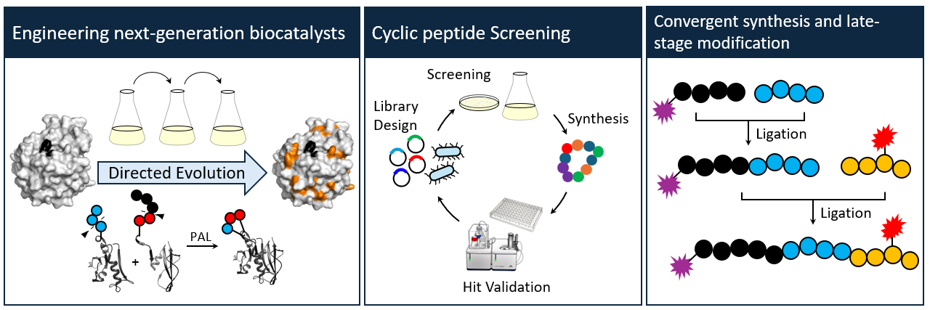
We develop new technologies based on peptide asparaginyl ligases, a class of enzymes that join and cyclise peptides with exceptional precision and efficiency. Our research spans three interconnected areas. (1) We engineer next-generation biocatalysts using directed evolution to improve enzyme performance and expand their capabilities. (2) We exploit ligases activities to modify peptides inside living cells, enabling the development of intracellular cyclic peptide screening platforms for sustainable discovery of new therapeutics. (3) We apply biocatalytic ligation technologies to support the convergent synthesis and late-stage functionalisation of synthetic peptides and semi-synthetic proteins, creating sustainable and efficient routes to complex biomolecules with applications in biotechnology and medicine.
Project example
Catalyst-Controlled Synthesis of Complex Amino Acids
We are developing new catalytic methods for the direct synthesis of structurally complex and non-natural amino acids (A vs B) from simple glycine derivatives and alkenes. To do this, we have invented an iridium-catalysed C(sp3)–H functionalisation platform, where coordination of the catalyst to the glycine… View project Close project
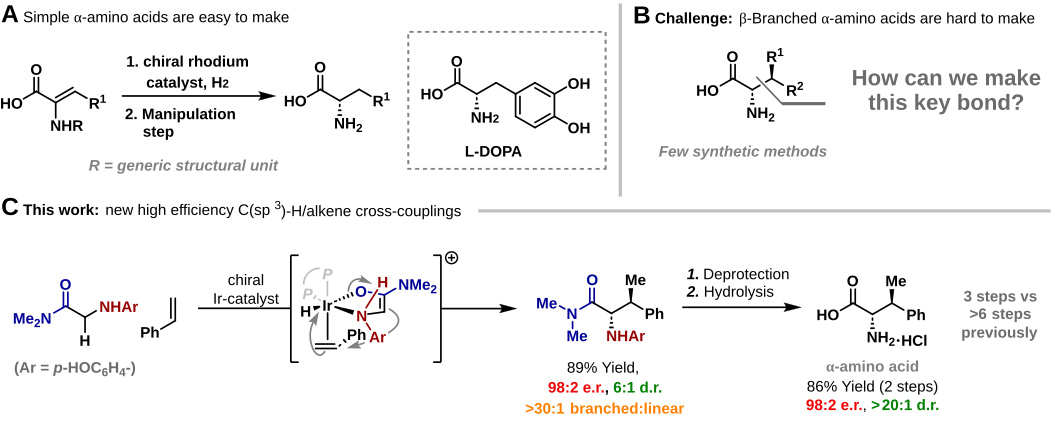
We are developing new catalytic methods for the direct synthesis of structurally complex and non-natural amino acids (A vs B) from simple glycine derivatives and alkenes. To do this, we have invented an iridium-catalysed C(sp3)–H functionalisation platform, where coordination of the catalyst to the glycine derivative triggers enolisation in advance of C-C bond formation via an unusual alkene carbometallation process (C). This provides a direct and atom-efficient way to form C–C bonds without requiring stoichiometric enolate generation or prefunctionalisation of either reaction partner. Ultimately, we aim to establish C(sp3)–H/alkene cross-coupling as a general platform for accessing amino-acid building blocks that are difficult to prepare using established methods.
References
- “A directed enolization strategy enables byproduct free construction of contiguous stereocentres en route to complex amino acids.” Nat. Chem. 2024, 16, 1125.
- “β-Quaternary α-amino acids via iridium-catalyzed branched and enantioselective hydroalkylation of 1,1-disubstituted styrenes.” Angew. Chem. Int. Ed. 2025, 64, e202504477.
Facilities and capabilities
Automated Synthesis & Reaction Optimisation
High-throughput experimentation, automated liquid handling and advanced reaction screening enable researchers to rapidly explore reaction conditions, catalysts and synthetic pathways. Flow chemistry and photochemical platforms further support efficient reaction discovery, optimisation and scale-up.
Reaction Analysis & Characterisation
Advanced analytical and reaction-monitoring facilities provide detailed insight into chemical transformations as they happen. Real-time reaction monitoring, alongside NMR, mass spectrometry and electrochemical techniques, supports kinetic and mechanistic studies, helping researchers understand and improve new synthetic and catalytic processes.
Meet the researchers
Dr Ulrich Hintermair
Chemistry
View profile›

Dr Alex Cresswell
Chemistry
View profile›

Dr Andreas Phanopoulos
Chemistry
View profile›

Dr Andrew Brennan
Life Sciences
View profile›

Professor Chris Bowen
Mechanical Engineering
View profile›

Dr Christopher de Leeuwe
Chemical Engineering
View profile›

Dr Daniel Scott
Chemistry
View profile›
Dr David Liptrot
Chemistry
View profile›

Dr Emma Denham
Life Sciences
View profile›

Dr James Taylor
Chemistry
View profile›
Dr Jamie Cadge
Chemistry
View profile›
Professor John Bower
Chemistry
View profile›

Dr Louis Morrill
Chemistry
View profile›

Dr Maria Shchepinova
Chemistry
View profile›

Dr Marina Uzelac
Chemistry
View profile›

Dr Matthew Grayson
Chemistry
View profile›
Dr Randolf Kohn
Chemistry
View profile›
Dr Scott Lovell
Life Sciences
View profile›

Dr Simon Freakley
Chemistry
View profile›

Professor Simon Lewis
Chemistry
View profile›

Dr Simon Tang
Life Sciences
View profile›

Dr Sourav Chatterjee
Chemical Engineering
View profile›

Susannah Coote
Professor Tony James
Chemistry
View profile›

Dr Veronica Ferrandiz-Mas
Architecture and Civil Engineering
View profile›Interested in this research theme?
Connected research
Explore our research themes
Our research themes are distinct but interconnected, combining expertise across disciplines to address complex sustainability challenges.